
Why the next breakthrough in research may have less to do with reading more, and more to do with thinking differently.
You’ve Been Reading Scientific Papers the Wrong Way
Imagine you’re a graduate student.
You download another journal paper. You open the PDF. Forty pages. Two hundred references. Equations, figures, tables, and enough technical jargon to make your coffee go cold before you reach the methodology.
An hour later you’ve highlighted half the paper.
The next day…
You can barely remember what it was about.
If that sounds familiar, you’re not alone.
For decades we’ve taught students what to read, but almost never how to read.
Ironically, the lesson may come from an unexpected teacher.
Artificial Intelligence.
Not because AI understands language like humans do.
It doesn’t.
But because Large Language Models (LLMs) reveal something fascinating about how information can be processed efficiently.
And in doing so, they unintentionally expose many of the habits that expert researchers have quietly developed over decades.
Wait… Are Humans Becoming Like AI?
No.
The comparison isn’t about intelligence.
It’s about strategy.
A modern LLM processes enormous amounts of text remarkably efficiently. It identifies relationships, recognises patterns, predicts what comes next, maintains context, and organises information into meaningful structures.
Now think about the best researcher you’ve ever met.
Perhaps your PhD supervisor.
Perhaps a senior engineer.
Perhaps a journal reviewer.
They rarely read every sentence with equal attention.
Instead, they seem to see through a paper.
Within minutes they understand the contribution.
They identify weaknesses.
They connect the work with ten other studies.
They ask questions nobody else noticed.
They’re not reading faster because they’re smarter.
They’re reading differently.
The Difference Between Reading and Processing
Most beginners believe reading is about collecting information.
Experts know reading is about building understanding.
Consider two researchers reading the same paper on geothermal reservoir modelling.
The first highlights every important sentence.
The second writes only four words in the margin:
“Fracture permeability dominates heat recovery.”
Who learned more?
Probably the second researcher.
Why?
Because understanding is compression.
If you cannot reduce an idea to one clear sentence, you probably haven’t understood it yet.
Your Brain Was Never Designed to Remember Everything
Students often try to memorise entire papers.
Experienced researchers rarely do.
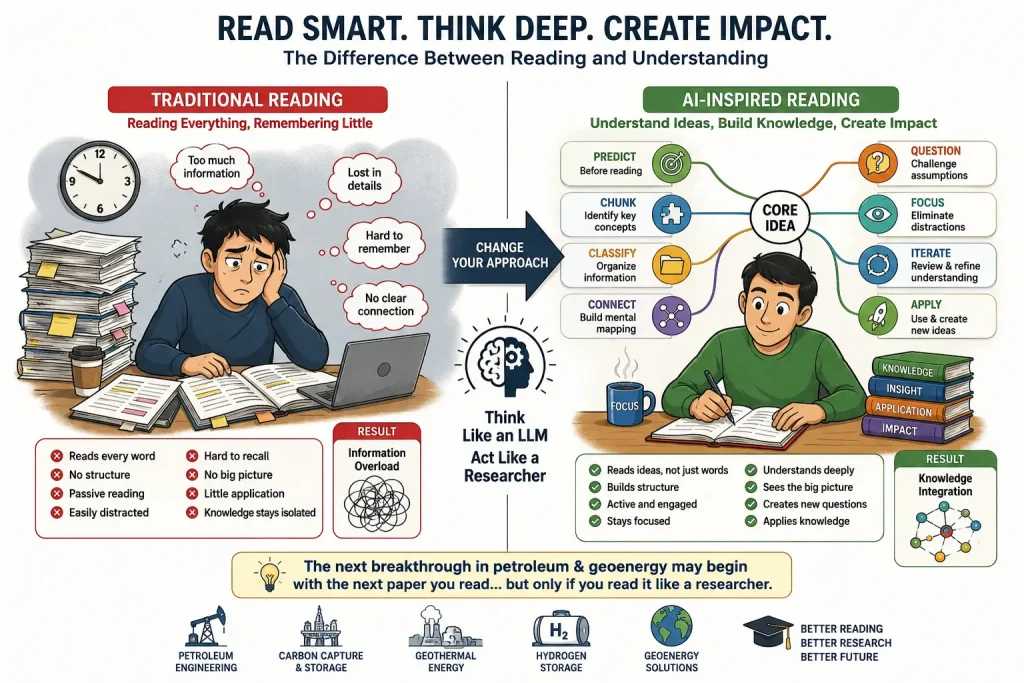
Instead, they organise information into concepts.
Suppose you’re reviewing Carbon Capture and Storage (CCS).
After twenty papers you could remember hundreds of individual observations.
Or you could organise everything into five themes:
- Reservoir characterisation
- Injectivity
- Caprock integrity
- Monitoring
- Risk assessment
Suddenly twenty papers become one mental map.
This is exactly how literature reviews become manageable.
Knowledge isn’t stored as a filing cabinet.
It’s organised as a network.
The Secret Journal Reviewers Rarely Mention
Here’s something interesting.
Journal reviewers almost never begin reading a manuscript from page one.
Instead they ask questions.
What problem is being solved?
Is this genuinely new?
Do the conclusions match the evidence?
Without realising it, reviewers predict the paper before reading it.
Every new section either confirms or challenges those expectations.
That’s remarkably similar to what LLMs do.
Not because the mechanisms are the same.
But because prediction is an efficient way to process information.
Good researchers don’t wait until the Discussion section to start thinking.
They begin thinking before they finish the title.
The Biggest Enemy Isn’t Complexity
It’s Distraction.
Modern research competes against notifications, emails, meetings, and social media.
Every interruption forces your brain to rebuild context.
Imagine reading a paper on hydrogen storage.
You’ve just understood the reservoir model.
Then your phone vibrates.
Five minutes later you return.
Your eyes recognise the words.
Your brain doesn’t recognise the argument.
Understanding isn’t lost because the paper changed.
It’s lost because context disappeared.
Deep reading requires uninterrupted thinking.
Why Reading More Papers Isn’t the Goal
Academics often celebrate how many papers they’ve read.
That’s the wrong metric.
The real question is simpler.
How many papers changed the way you think?
One carefully analysed paper may contribute more to your research than twenty papers skimmed in a hurry.
Expert researchers don’t chase quantity.
They chase insight.
Read Like an Engineer
Engineering has never been about memorising equations.
It’s about solving problems.
The same applies to reading.
Every paper should answer three questions.
What did I learn?
How can I apply it?
What new question does it create?
If a paper doesn’t change your understanding, improve your methodology, or inspire a better question, then its greatest value may have been missed.
Knowledge becomes powerful only when it is applied.
Perhaps AI Didn’t Change Reading…
Perhaps it simply revealed it.
Large Language Models didn’t invent prediction.
They didn’t invent pattern recognition.
They didn’t invent hierarchical thinking.
Humans have been using these strategies for centuries.
Scientists.
Engineers.
Physicians.
Lawyers.
Chess masters.
Expert readers.
What AI has done is expose these cognitive principles in a way we’ve never seen before.
For the first time, we can observe another information-processing system and ask an unusual question:
“Is this what expertise has looked like all along?”
That question may be one of AI’s most valuable contributions to education.
The Challenge
The next time you open a scientific paper, don’t ask,
“How quickly can I finish this?”
Instead ask,
“How deeply can I understand it?”
Read ideas.
Predict.
Build mental maps.
Question assumptions.
Compress complexity.
Apply knowledge.
Those habits won’t simply help you read papers faster.
They’ll help you become the kind of researcher whose work others want to read.
Continue the Journey
This article introduces the core ideas, but each strategy is explored in greater depth in my 31-minute lecture:
🎥 “Think Like an LLM: 12 Reading Strategies Every Researcher Should Know“
The lecture demonstrates how these principles can improve literature reviews, critical reading, journal reviewing, and research productivity, with examples from petroleum engineering, carbon capture and storage, geothermal energy, hydrogen storage, and the broader geoenergy sector.
If you’re a student, researcher, engineer, or journal reviewer, the next paper you read may become the most valuable one of your career, not because of what it contains, but because of how you choose to read it.