
Hydraulic Fracture Explorer brings three classical fracture models to a browser tab — and, unusually for engineering software, shows exactly where its own numbers came from, including the mistakes it caught along the way.
There is a particular kind of gap that shows up in almost every technical field eventually: the distance between what a textbook teaches and what the industry actually uses. In hydraulic fracturing — the process that opens channels in rock so oil and gas can flow to a wellbore — that gap has historically been bridged one of two ways. An engineer works through static equations on a page, or a company hands them a commercial simulator that costs real money to license and takes real time to learn, long before they have any feel for how the underlying physics actually behaves.
Hydraulic Fracture Explorer, a new tool from Carbon Strata Solutions, is aimed squarely at that gap — not by replacing the commercial packages engineers already rely on, but by giving the fundamentals somewhere to live that isn’t a spreadsheet or a slide deck.
Three Models, One Afternoon
The software implements the three classical analytical models taught in petroleum engineering programs worldwide: PKN (Perkins–Kern–Nordgren), KGD (Khristianovic–Geertsma–de Klerk), and Radial. Each makes a different assumption about how a fracture grows — height-confined and long, width-dominated and short, or spreading outward like a coin — and picking the right one for a given rock is itself a real engineering judgment call the software walks through.
It runs from a single HTML file. No installation, no license server, no account, no internet connection required after download. Open it, and a fracture initiates, propagates, leaks fluid into the formation, carries proppant, and closes — all while sixteen-plus engineering parameters, from injection rate to fracture toughness to well depth, stay live and adjustable, with the physics visibly responding to every change.
Six Stages, Real Physics
The animation is broken into six stages — Wellbore Pressurization, Fracture Initiation, Fracture Propagation, Fluid Leak-off, Proppant Transport, and Fracture Closure — and each is tied to an actual governing equation rather than a scripted visual effect. Net pressure comes from a coupled balance between the rock’s fracture toughness and the fluid’s viscous resistance to flow. Leak-off is tracked causally: fluid loss only begins the instant a given patch of fracture face is created, not from the start of pumping, which is a meaningfully different (and more defensible) assumption than the static design methods most textbooks teach.
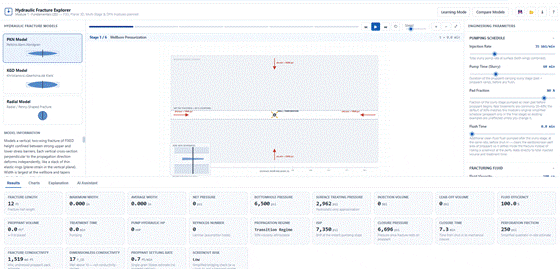
Hydraulic Fracture Explorer’s four-panel interface: model selection, the fracture visualization, the engineering-parameter panel, and a live results grid, shown at the very start of a PKN treatment.
Proving It’s Not Just a Pretty Animation
What sets this apart from a typical engineering demo isn’t the animation — it’s the paper trail behind it. Rather than simply asserting the physics is correct, the software ships with a validation report that reproduces a fully worked, independently published example from a standard petroleum engineering reference textbook, matching the source’s own published numbers to within 1–2%.
The independent reproduction in this report matches the published solution to within 1–2% on injection time, fluid efficiency, and the leak-off coefficient Kₗ — confirming that this report’s transcription of the reference equations and the simulator’s own KGD implementation are both correctly grounded in the published method.
— Hydraulic Fracture Explorer Validation Report
For the cases where no published numerical example existed to check against — a conventional reservoir, a shale play, a coal seam — the report instead runs an independent hand calculation and compares it to the simulator directly, and is candid where the two disagree. In one case, a static textbook design method and the simulator’s own time-marching model diverge by nearly an order of magnitude on treatment efficiency — not because either is wrong, but because they are solving genuinely different problems, a distinction the report walks through rather than papering over.
What It Won’t Tell You
The software is direct about its own boundaries, which is rarer in engineering software than it should be. It does not model height growth beyond a fixed pay-zone thickness, does not resolve how proppant concentration varies spatially along the fracture, and does not forecast production. Those are explicitly reserved for later modules — Pseudo-3D, full Planar 3D, multi-stage fracturing, and discrete fracture networks — rather than quietly approximated in the current one. Where a slider has a limited effect for good physical reasons, the software says so in its own documentation instead of leaving the user to guess.
Not Built to Stand Alone
Hydraulic Fracture Explorer is positioned as the first module in a longer-running platform, with the same architecture intended to carry forward as later modules add the complexity this one deliberately leaves out. For now, its case rests on a narrower claim: that the fundamentals of fracture design deserve an interactive, verifiable, zero-friction way to learn and communicate them — whether that’s a new hire building intuition before touching a commercial simulator, a professor replacing static slides with a live model in front of a class, or an engineer explaining a treatment design to a landowner or regulator who has never seen a stress tensor.
Watch It Run
A recorded walkthrough of the software in action is available here:
Hydraulic Fracture Explorer, Module 1: Fundamentals (2D), was developed by Dr. Mansoor Zoveidavianpoor, CEng, of Carbon Strata Solutions.
More information: https://carbonstrata.org/software-solutions/