
Victoria’s geothermal resource has remained constant. The change lies in how it is being assessed and applied.
Current evaluation is driven by system requirements—cost efficiency, emissions reduction, and energy stability—but geothermal performance depends on three interacting factors:
- geology
- cost of access
- regulatory conditions
No single factor determines viability in isolation.
Resource Characteristics: Depth, Temperature, and Accessibility
Geothermal assessments across the Gippsland and Otway basins indicate subsurface temperatures exceeding 150 °C at depths of approximately 3–4 km. These conditions are sufficient for electricity generation using binary-cycle systems.
This establishes technical feasibility.
Access, however, requires deep drilling and engineered reservoirs. These introduce high capital costs and increase project complexity. Exploration has consistently confirmed thermal resource presence, but this has not translated into widespread development.
The limiting condition is the cost required to access and sustain heat extraction at depth.
Direct Use: Deployment at Lower Cost Thresholds
Where geothermal resources are accessible at lower depth and temperature, deployment becomes more practical.
A system in Traralgon extracts groundwater at approximately 67 °C from a depth of 644 m for direct heating. Similar resource conditions exist in the Latrobe Valley, where a regional aquifer provides moderate-temperature heat over a broad area.
These applications share common characteristics:
- moderate depth
- moderate temperature
- no requirement for electricity generation
- limited drilling complexity
Deployment occurs where thermal energy can be accessed without deep, high-cost infrastructure.
Legal Definition and Resource Control
Under the Geothermal Energy Resources Act 2005 (Vic), geothermal energy is defined broadly as heat contained within the earth and associated materials.
The resource is owned by the Crown. Access requires authorisation.
The Act regulates:
- exploration
- extraction
- geothermal operations
It does not impose temperature or depth thresholds. Regulatory scope is determined by the nature and scale of activity.
Small-scale and non-commercial systems, including ground-source heat pumps, are excluded from full regulatory control.
Operational Thresholds and Exemptions
The operational boundary is defined in the Geothermal Energy Resources Regulations 2026.
Exploration and extraction activities are exempt where the geothermal resource:
- is below 70 °C; or
- is located at a depth of less than 1 km [Geothermal…ation 2026 | PDF]
These thresholds determine when the Act does not apply.
The effect is a functional distinction:
- shallow or low-temperature systems operate outside the full licensing framework
- deeper or higher-temperature systems require regulatory approval
Entry into the regulated system occurs when geothermal activity involves engineered subsurface access beyond shallow conditions.
Licensing Structure
Geothermal development is governed through a staged licensing system:
- exploration permits for resource identification
- retention leases where development is not yet viable
- extraction licences for production
Access is conditional. Proponents must demonstrate technical capability, financial capacity, and a defined program of work.
The resource is managed rather than freely accessible.
Operational and Environmental Requirements
The Regulations impose structured requirements on geothermal activities, including:
- preparation of operation plans
- identification and management of environmental risks
- well design and integrity controls
- reporting of activities and incidents [Geothermal…ation 2026 | PDF]
These requirements define operating conditions and ensure that geothermal activities are conducted within established safety and environmental parameters.
System Function
The regulatory framework sets boundaries for access and operation. It does not determine project viability.
Project outcomes are influenced by:
- capital cost of drilling and infrastructure
- achievable energy output
- site-specific conditions
Only projects that satisfy both economic and regulatory requirements progress.
Technology Direction
Geothermal development in Victoria is shifting toward lower-cost applications.
Current activity emphasises:
- direct heat use
- distributed thermal systems
- integration with industrial and building-scale demand
Electricity generation from deep geothermal resources remains technically feasible but economically constrained.
Thermal Performance
Thermal system performance highlights relative efficiency:
- electric resistance heating: ~1:1
- air-source heat pumps: ~2–3
- ground-source systems: ~4–5
This reflects differences in how heat is produced or transferred.
Geothermal systems benefit from stable subsurface temperatures. However, system performance must be evaluated alongside capital cost and installation requirements.
Commercial Outcomes of Deep Geothermal
Deep geothermal projects in Australia have demonstrated that high-temperature resources can be accessed [GeoVic].
A critical constraint in assessing geothermal potential in Victoria is the uneven spatial distribution of subsurface temperature data. Most available measurements are derived from petroleum wells and groundwater boreholes, with a strong concentration in the Gippsland and Otway basins. This reflects historical exploration activity rather than true resource distribution, creating areas of high confidence alongside large regions of data uncertainty.
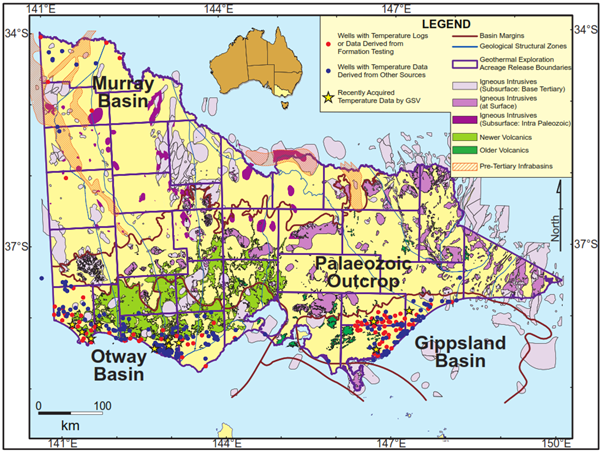
Figure 1: Spatial distribution of geothermal data control in Victoria, showing well and borehole locations and sites of validated temperature measurements (modified after Driscoll, 2006).
Areas with dense well control in Figure 1 provide reliable geothermal gradient estimates, whereas regions with sparse data remain underexplored despite potentially favorable geological conditions.
Data clustering in the Gippsland and Otway basins highlights strong exploration bias and uneven subsurface temperature control, which directly affects geothermal resource confidence.
This uneven data distribution translates directly into uncertainty in temperature predictions at depth and increases exploration risk across poorly constrained regions.
Despite favorable geothermal indicators, commercial development in Victoria has been constrained by a combination of technical, economic, and spatial limitations, including:
- drilling and infrastructure costs
- location constraints
- system integration challenges
Technical feasibility does not ensure economic viability.
Application in Victoria
Geothermal development is shaped by three constraints:
- accessibility of the resource
- cost of extraction
- regulatory requirements
Direct-use applications proceed where these factors align.
Deep geothermal energy for electricity generation remains dependent on changes in cost structure and project delivery conditions.
The framework defines how geothermal can be accessed and used. It does not alter the underlying economic conditions.
References
Legislation
- Geothermal Energy Resources Act 2005 (Vic)
- Geothermal Energy Resources Regulations 2026 (Vic), S.R. No. 17/2026
Government and Institutional Sources
- Resources Victoria – Geothermal energy and GeoVic database
- Driscoll, J. (2006). Geothermal Prospectivity of Onshore Victoria, Australia. Victorian Initiative for Minerals and Petroleum Report 85. Department of Primary Industries, Victoria.
- Geoscience Australia – Geothermal resource assessments
- CSIRO – Subsurface temperature and geothermal potential studies
Exploration and Technical Studies
- Victorian Geothermal Atlas Project (2010–2015)
- Gippsland and Otway Basin geothermal assessments
Projects and Case Studies
- Gippsland Regional Aquatic Centre geothermal heating system
- Latrobe Valley geothermal aquifer resource
- Cooper Basin (Habanero Project, Geodynamics Ltd)
Industry and Market Development
- Australian Renewable Energy Agency (ARENA) – geothermal programs
- ThinkGeoEnergy – geothermal project database and analysis
- Ecogeneration Australia – renewable energy industry reporting
Research and Academic Contributions
- University of Melbourne – geothermal heat pump research
- Metro Tunnel geothermal pilot system
- Energy wall and ground heat exchanger research
Technical Performance References
- Standard HVAC system performance benchmarks (electric, air-source, and ground-source heat pumps)