
Pohang, South Korea — It was meant to be a milestone for clean energy. Instead, it became one of the clearest warnings about the risks of engineering deep beneath the Earth’s surface.
The Pohang Enhanced Geothermal System project set out to prove that countries without volcanic resources could still tap geothermal energy. What it ultimately proved was something far more uncomfortable. When subsurface risks are underestimated, the consequences can surface fast and at scale.
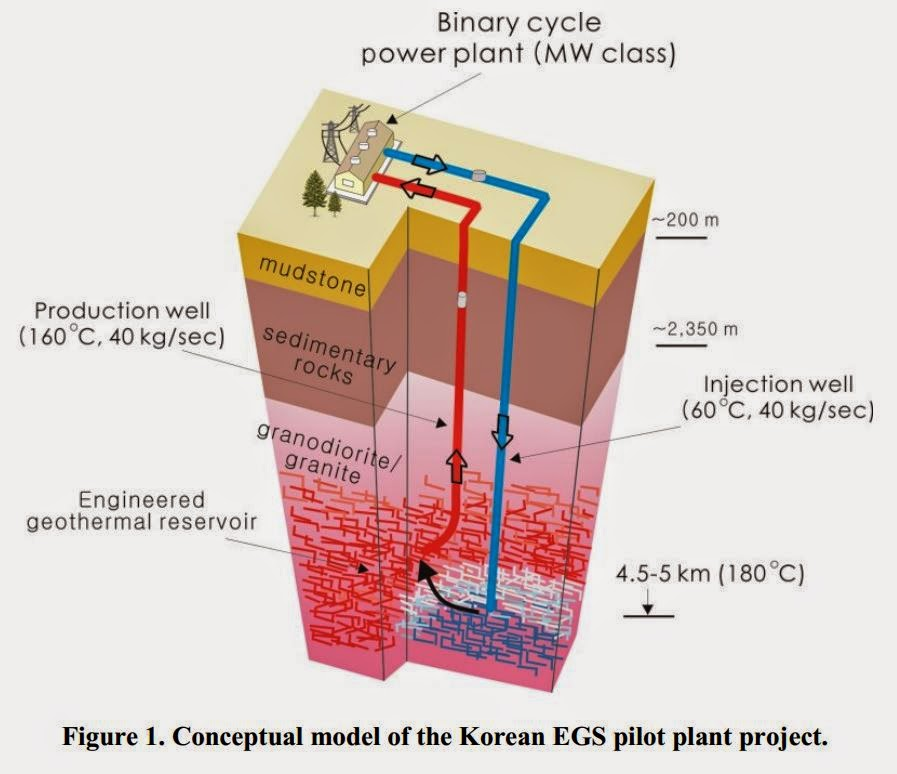
A bold experiment underground
The project began in 2010 with a clear objective: generate electricity by extracting heat from deep crystalline rock more than four kilometers below ground. Engineers drilled two wells, PX 1 and PX 2, targeting temperatures high enough to support power generation.
Unlike conventional geothermal fields, Pohang had no natural permeability. Water could not move freely through the rock.
To solve this, engineers relied on hydraulic stimulation. High pressure water was injected into the formation to open fractures and create artificial flow paths between the wells.
The injections were not minor. Individual campaigns involved high pressures and thousands of cubic meters of fluid pushed into the reservoir.
From a technical standpoint, the system responded. Fractures expanded. Flow improved. Microseismic monitoring showed that the reservoir was being successfully stimulated.
In isolation, those results suggested progress.
They did not tell the full story.
The day the ground moved
On November 15, 2017, Pohang was struck by a magnitude 5.4 to 5.5 earthquake. It damaged buildings, injured residents, and forced large numbers of people from their homes.
The location of the earthquake immediately raised concerns. The epicenter lay directly beneath or very close to the geothermal site.
Scientific investigations that followed reached a consistent conclusion. The earthquake was linked to the project.
Researchers found that injected fluid had increased pore pressure along a fault that was already close to failure. That increase reduced friction along the fault, ultimately triggering a rupture.
Further analysis confirmed that fluids migrated into a critically stressed fault zone, initiating slip.
This was not a minor technical issue. It was a defining moment for the industry. The Pohang earthquake is widely regarded as the largest seismic event ever associated with an enhanced geothermal project.
Before Pohang, induced seismicity in geothermal operations was typically small. Pohang showed that assumption could fail.
A project unravels
The consequences were immediate.
The earthquake injured dozens of people and caused significant economic damage.
Public trust collapsed. The project was suspended and eventually abandoned.
Authorities responded by tightening oversight of deep geothermal developments and placing greater emphasis on seismic risk management.
The failure was not rooted in a lack of engineering capability. It was rooted in incomplete risk awareness.
What the evidence makes clear
Subsequent studies removed much of the uncertainty.
Researchers showed that the earthquake originated within the same rock volume that had been stimulated during injection campaigns.
Seismic activity increased in direct relation to injection operations and could be spatially linked to the wells.
High pressure injection activated a previously unmapped fault, connecting the engineering activity to the tectonic response.
Even the timing was explained. The largest event occurred weeks after injection ended, as pressure continued to migrate through the subsurface and reach the fault.
Taken together, these findings form a consistent chain. The project altered subsurface stress conditions. Those changes triggered a fault. The fault produced a damaging earthquake.
Lessons written in failure
The Pohang project did not fail because geothermal energy is unworkable. It failed because critical risks were not treated as primary constraints.
Faults were not mapped and characterized with sufficient detail before stimulation.
Injection pressures were designed to enhance permeability, not to limit seismic hazard.
Monitoring systems recorded seismic signals but did not prevent escalation.
Most importantly, the project treated engineering success and overall success as the same thing. They are not.
A system that delivers flow but triggers a damaging earthquake is a failure.
A shift in how projects are built
Pohang forced a change in thinking across the geothermal industry.
Fault characterization is now treated as essential, not optional.
Injection strategies are increasingly designed around geomechanical limits, not just reservoir performance.
Seismic risk is integrated into project design from the beginning, rather than addressed after operations begin.
Researchers stress that fluid injection has long been known to trigger earthquakes, but the scale observed in Pohang showed that existing models underestimated the risk under certain geological conditions.
Bottom line
The Pohang project proved that engineered geothermal systems can unlock energy from rock formations that were once considered inaccessible.
It also proved that the subsurface is not a passive system.
When you increase pressure deep underground, you interact with faults that can release energy far beyond your design assumptions.
That is the real lesson.
You are not just extracting heat.
You are altering a stressed geological system.
If you misjudge that system, the consequences will not stay underground.
References
- Kim, K. H. et al. (2018). Assessing whether the 2017 Mw 5.4 Pohang earthquake was an induced event. Science.
- Ellsworth, W. L. et al. (2019). Triggering of the Pohang earthquake by EGS stimulation. Seismological Research Letters.
- Stanford Doerr School (2019). Lessons from Pohang: Solving geothermal energy’s earthquake problem.
- Bethmann, F. et al. (2021). Seismicity analysis related to the Pohang geothermal project. World Geothermal Congress.
- Tian, Y. and Horne, R. (2025). Induced seismicity mechanisms in the Pohang EGS. Stanford Geothermal Program.
- Park, S. et al. (2020). Hydraulic stimulations in the Pohang geothermal site. Geothermics.
- Qian, J. W. et al. (2024). Seismic tomography of the Pohang earthquake source. Earth and Planetary Physics.
- Kim, K. H. et al. (2018). Induced seismicity and the Pohang earthquake.