
In oil and gas, bigger has long been mistaken for better.
Open the well. Push the flow. Maximize the output.
For decades, the instinct has been simple: if a gas well can produce more, it should. But across boardrooms, control rooms, and regulatory offices, that belief is quietly unraveling.
Because in reality, the most valuable wells in the world are not the ones that produce the fastest.
They are the ones that produce the smartest.
At the center of this shift lies a deceptively simple concept: Maximum Efficient Rate (MER).
The Counterintuitive Truth of Production
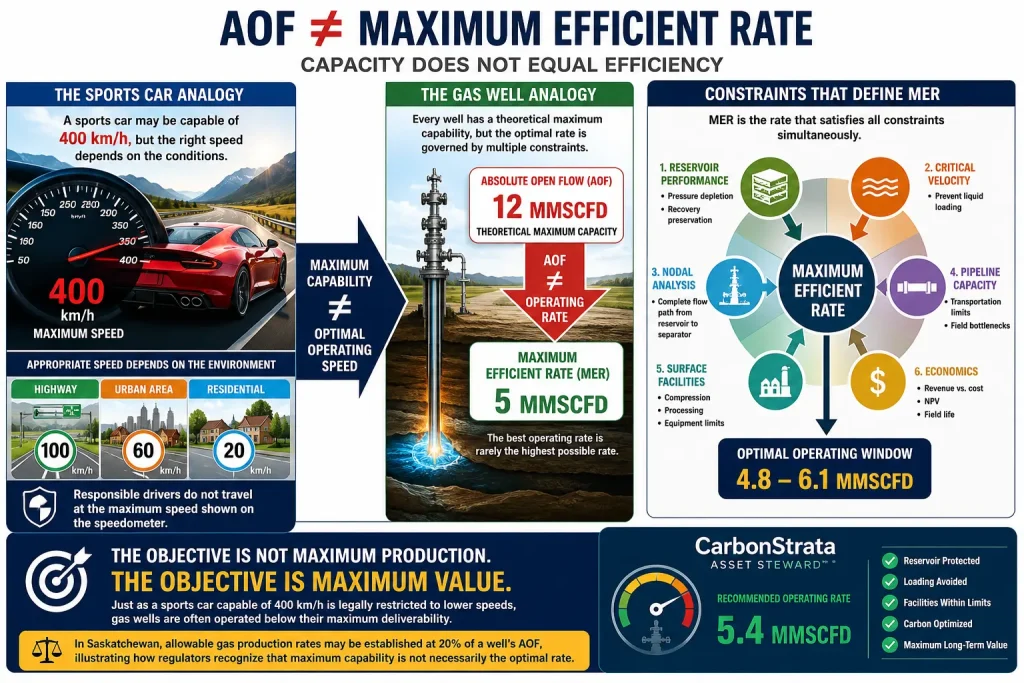
A gas well can flow at astonishing rates when unconstrained. Engineers define this upper limit as the Absolute Open Flow (AOF) a theoretical maximum representing what the reservoir could deliver under ideal conditions.
But MER asks a different question altogether:
Just because you can produce at that rate, should you?
The answer, increasingly, is no.
MER is the highest sustainable production rate that balances reservoir health, operational constraints, and long-term economic value, not the maximum rate a well can physically achieve.
This distinction is not academic. It is fundamental.
Producing at maximum capacity may boost early cash flow, but it often comes at a hidden cost: faster pressure depletion, reduced recovery, premature compression requirements, and ultimately, a shorter and less profitable field life.
The Difference Between Capacity and Efficiency
Imagine owning a sports car with a speedometer that goes up to 400 km/h.
The car may be capable of reaching that speed under ideal conditions, but no one drives at 400 km/h all the time. On highways, in cities, or through residential areas, speed is adjusted based on safety, infrastructure, and long-term efficiency.
Gas wells operate in much the same way.
Every well has a theoretical maximum production capacity, known as the AOF, the equivalent of the car’s top speed. It reflects what a well could deliver under ideal conditions, not what it should deliver in practice.
In reality, the optimal production rate is almost always lower, because multiple constraints must be respected.
First, there is the reservoir. Producing too aggressively can accelerate pressure depletion and reduce long-term recovery.
Second, there is the wellbore. Gas wells often carry liquids such as water or condensate, which require a minimum gas velocity, known as the critical velocity—to stay lifted to the surface. If this balance is disrupted, liquid loading can reduce production efficiency.
Third, the production system must be considered. From tubing and chokes to compressors and separators, every component in the flow path imposes limits. Engineers evaluate this through nodal analysis, ensuring the entire system (not just the reservoir) can sustain the chosen rate.
Beyond the well itself, pipeline capacity and surface facilities impose additional constraints. Exceeding these limits can create bottlenecks, pressure losses, and operational inefficiencies across the field.
Finally, economics plays a decisive role. Producing faster may generate higher short-term revenue, but it can also increase costs, shorten field life, and reduce total value.
MER is therefore not defined by a single limit; it is the point where all of these factors are balanced.
- Reservoir performance
- Critical velocity requirements
- System (nodal) constraints
- Pipeline capacity
- Surface facility limits
- Economic objectives
Just as responsible drivers do not operate at maximum speed, responsible operators do not produce at maximum deliverability.
The goal is not maximum production.
The goal is maximum value.
And this principle is not just theoretical. In Saskatchewan, for example, regulatory guidelines may limit production to 20% of a well’s AOF, reinforcing a simple but powerful idea:
Maximum capability does not equal optimal operation.
When Speed Destroys Value
The effects of overproduction rarely appear immediately.
At first, the numbers look impressive, strong initial rates, rapid revenue generation, and seemingly efficient operations. But beneath the surface, the reservoir is being stressed.
Pressure declines faster. Water and condensate breakthrough accelerates. Flow assurance becomes more complex. Infrastructure begins to strain.
And slowly, almost invisibly, the asset loses its long-term potential.
This is the central paradox of gas production:
Short-term gains can quietly erode long-term value.
Havlena and Paxman recognized this as early as 1966, demonstrating that ultimate recovery is maximized not at the highest production rate, but at an optimal, finite rate shaped by reservoir behavior and depletion dynamics.
In other words, producing too fast can mean leaving gas in the ground forever.
Engineering Meets Reality: Constraints Everywhere
MER exists because no well operates in isolation.
Production decisions must satisfy a web of competing constraints:
- Reservoir performance – Avoiding rapid pressure depletion
- Critical velocity – Preventing liquid loading in the wellbore
- Surface facilities – Respecting equipment limits
- Pipeline capacity – Managing system bottlenecks
- Economics – Balancing revenue against long-term asset value
Each of these factors pulls the “optimal rate” in a different direction. MER is where they converge.
Like driving a high-performance car, capability is not the same as wisdom. The presence of power does not justify its constant use.
When Governments Agree with Engineers
Perhaps the strongest validation of MER comes not from theory, but from regulation.
Around the world, regulators have embedded the principle directly into law: do not produce at maximum capability.
In Saskatchewan, Canada, gas wells are typically limited to 20% of their AOF.
In Oklahoma, discovery wells may be capped at 65% of AOF during early production.
In U.S. offshore operations, regulators can impose MER limits if high production rates risk damaging ultimate recovery.
Different systems, same message:
Maximum capability is not the same as optimal production.
More advanced frameworks, such as the UK’s Maximising Economic Recovery (MER UK) and Norway’s prudent production philosophy, go even further—requiring operators to demonstrate that their production strategies maximize long-term recovery and value.
The idea is no longer optional.
It is institutional.
The Rise of “Dynamic MER”
Historically, MER was treated as a fixed engineering target, a number determined during field development and revisited only occasionally.
Today, that approach is becoming obsolete.
Modern gas fields operate in an environment of constant change:
- Declining reservoir pressure
- Changing market prices
- Evolving infrastructure constraints
- Increasing emissions pressures
The “right” production rate today may be the wrong one six months from now.
As a result, engineers are increasingly treating MER not as a number, but as a moving target.
By integrating real-time data, nodal analysis, deliverability models, and economic forecasting, operators can continuously adjust production strategies to maximize value across the field’s life.
This is the emergence of dynamic MER, a shift from static optimization to continuous decision-making.
Beyond Engineering: The Economics of Discipline
Perhaps the most important evolution in MER is not technical, but philosophical.
For years, engineering and economics operated in parallel. Engineers maximized production. Economists evaluated outcomes.
Today, those disciplines are merging.
A production strategy must now satisfy both:
- Technical integrity (reservoir health, flow assurance, system performance)
- Financial performance (net present value, recovery factor, operating cost efficiency)
In this integrated view, success is not defined by how much gas is produced, but by how much value is created.
And often, that means producing less.
A Shift in Mindset
MER challenges one of the oldest assumptions in the energy industry: that more production automatically leads to more profit.
It replaces that idea with something more nuanced, and more powerful:
The objective is not to maximize output.
It is to maximize value.
In a world of tighter margins, aging assets, and increasing scrutiny on resource stewardship, this shift is not just theoretical.
It is essential.
The Future Belongs to Restraint
As digital technologies, artificial intelligence, and advanced reservoir modelling continue to evolve, MER will become even more central to production strategy.
Future systems will not simply monitor production.
They will continuously recommend optimal operating conditions, balancing physics, infrastructure, and economics in real time.
In that future, success will no longer belong to operators who produce the fastest.
It will belong to those who understand when not to.
Final Thought
A gas well, like any powerful system, rewards discipline more than aggression.
It offers its greatest value not to those who push it hardest, but to those who understand it best.
MER is not about limitation.
It is about precision.
And in modern energy production, precision is everything.
References
Abu Dhabi National Oil Company (ADNOC). (n.d.). Maximizing recovery and reservoir management. https://www.adnoc.ae
Craft, B. C., Hawkins, M. F., & Terry, R. E. (1991). Applied petroleum reservoir engineering (2nd ed.). Prentice Hall.
Danish Energy Agency. (n.d.). Oil and gas regulation under the Danish Subsoil Act. https://ens.dk
Egyptian General Petroleum Corporation. (n.d.). Petroleum development and field management guidelines. https://www.egpc.com.eg
Federal Republic of Germany. (n.d.). Federal Mining Act (Bundesberggesetz). https://www.gesetze-im-internet.de/bbergg/
Government of Saskatchewan. (n.d.). Directive PNG011: Allowable rate of production – gas wells.
https://www.saskatchewan.ca/business/agriculture-natural-resources-and-industry/oil-and-gas/oil-and-gas-licensing-operations-and-requirements/oil-and-gas-drilling-and-operations/oil-and-gas-production/allowable-rate-of-production-for-gas-wells
Government of the Netherlands. (n.d.). Mining Act (Mijnbouwwet). https://wetten.overheid.nl/BWBR0014168/
Havlena, D., & Paxman, J. (1966). Material balance analysis of oil reservoirs. Society of Petroleum Engineers.
Italian Ministry of Environment and Energy Security. (n.d.). UNMIG – National mining office for hydrocarbons and georesources. https://unmig.mase.gov.it
Ministry of Energy and Minerals (Oman). (n.d.). Petroleum development and enhanced oil recovery policies. https://www.mem.gov.om
National Offshore Petroleum Titles Administrator (NOPTA). (n.d.). Rate of recovery. https://www.nopta.gov.au/application-processes/development/rate-of-recovery.html
North Sea Transition Authority. (2016). The maximising economic recovery (MER UK) strategy. UK Government.
https://www.gov.uk/government/publications/maximising-economic-recovery-of-uk-petroleum-the-draft-mer-uk-strategy
Norwegian Offshore Directorate (SODIR). (1996). Act of 29 November 1996 No. 72 relating to petroleum activities.
https://www.sodir.no/en/regulations/acts/act-29-november-1996-no2.-72-relating-to-petroleum-activities/
Oklahoma Corporation Commission. (2022). Oklahoma Statutes Title 52 §29.
https://law.justia.com/codes/oklahoma/2022/title-52/section-52-29/
QatarEnergy. (n.d.). Field development and reservoir management. https://www.qatarenergy.qa
Resources Victoria. (n.d.). Developing an offshore petroleum resource: Applications for field development plan and rate of recovery.
https://resources.vic.gov.au/legislation-and-regulations/guidelines-and-codes-of-practice/developing-an-offshore-petroleum-resource
Saudi Aramco. (n.d.). Reservoir management and maximizing hydrocarbon recovery. https://www.aramco.com
Society of Petroleum Engineers. (n.d.). SPE 19080: Maximum efficient rate evaluation for gas reservoirs.
Society of Petroleum Engineers. (n.d.). SPE 26633: Determination of maximum efficient rate in gas reservoirs.
Society of Petroleum Engineers. (n.d.). SPE 30787: Production rate effects on gas reservoir recovery.
Texas Railroad Commission. (n.d.). 16 TAC §3.28 – Potential and deliverability of gas wells to be ascertained and reported.
https://www.law.cornell.edu/regulations/texas/16-Tex-Admin-Code-SS-3-28
Texas Railroad Commission. (n.d.). 16 TAC §3.31 – Gas reservoirs and gas well allowable.
https://regulations.justia.com/states/texas/title-16/part-1/chapter-3/section-3-31/
U.S. Bureau of Safety and Environmental Enforcement. (n.d.). 30 CFR §250.1159 – Maximum efficient rate (MER) and maximum production rate (MPR).
https://www.law.cornell.edu/cfr/text/30/250.1159
Zhuang, H. (2013). Dynamic well testing in petroleum exploration and development. Gulf Professional Publishing.
Great content! Keep up the good work!